The Abundance Paradox: Why the World's Largest Reserves Lie Dormant
Bolivia holds the planet's largest lithium reserves, an impressive 23,000 kt. Yet this monumental figure contrasts sharply with its actual production capacity, which is marginal in a regional market dominated by Chile and Argentina, exceeding 80,000 tonnes annually. This gap is no accident — it stems from a complex combination of political, technological and economic factors that impede project scalability.
The Bolivian case is the clearest demonstration that having the resource is not enough. For investors, it is a lesson that on-the-ground risk — political and execution-related — outweighs geological potential, making assets in lower-potential but higher-predictability jurisdictions more attractive.
The Golden Rule: Investment Follows Predictability, Not Just the Mineral
At the opposite end of the Bolivian spectrum, Argentina demonstrates how a favorable regulatory direction can awaken capital and accelerate production, even with considerably smaller reserves. In the critical minerals sector, regulatory direction has become as decisive a factor as geology itself.
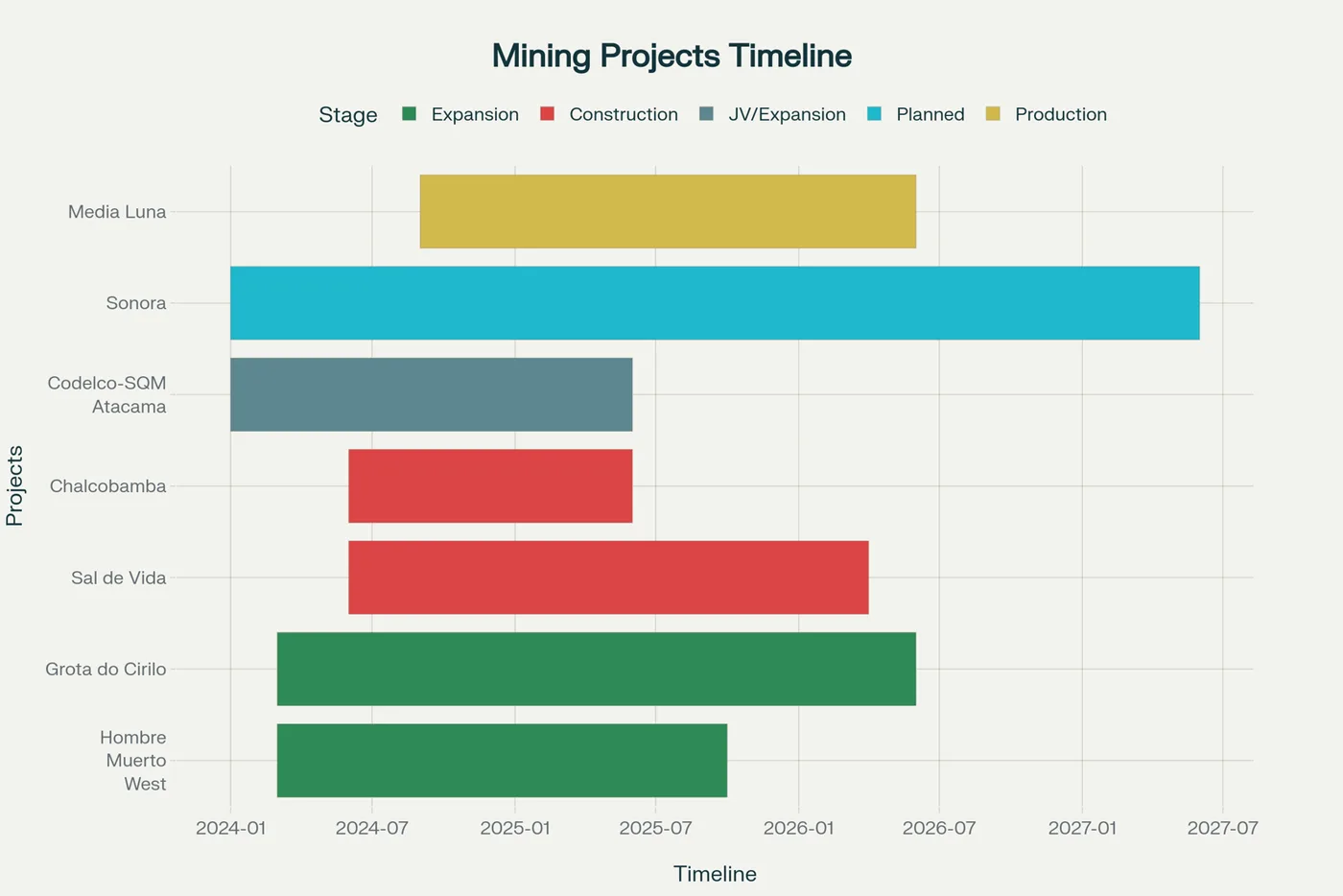
Argentina's lithium sector, with a compound annual growth rate of 21%, is the best example. This dynamism responds directly to an incentive-driven acceleration strategy, embodied by the Large Investment Incentive Regime (RIGI) — a test case for fiscal stability and export frameworks. This regime has underpinned the development of key projects such as Hombre Muerto West and Allkem's Sal de Vida.
Supply will scale where there is regulatory predictability, not just geological wealth.
This reality confirms for investors that policy continuity is the most reliable indicator of future productive capacity growth.
Timeline of strategic mining projects across the region, 2024–2027. Projects spanning production, construction, expansion, and planning stages. Source: Pacific Basin Intelligence Unit analysis.
Neither Full Nationalization nor Open Market: The Rise of Chile's Hybrid Model
Between the extremes of full nationalization and unrestricted openness, a new pragmatic model is emerging: hybrid sovereignty. Chile pioneered this approach with the landmark agreement between state-owned Codelco and private SQM at the Salar de Atacama — a joint venture set to operate from 2025 through 2060.
The appeal of this structure lies in its balance: it allows the state to capture a significant share of rents and maintain strategic control over a vital resource, while retaining the operational efficiency, capital, and technical expertise that the private sector brings.
The Green Seal: How ESG Criteria Became a Financing Requirement
Compliance with Environmental, Social and Governance (ESG) criteria has ceased to be an optional add-on and become a central investment strategy. Brazil demonstrates this in its nickel sector, where it aims to reach a regional share of approximately 16.6% by 2030 by combining its resource wealth with ESG and traceability initiatives.
Today, ESG standards and safety conditions are factors that define a project's bankability. This strategy not only mitigates reputational risk — it unlocks access to green financing and capital from funds operating under strict ESG mandates, turning compliance into a direct competitive advantage.
The State as Partner: Mexico's Nationalization Did Not Close Every Door
While Chile opts for a strategic partnership with shared control, Mexico presents another facet of resource nationalism, where the state acts as the primary operator but leaves the door open to private investment under strictly defined conditions. Mexico's recent mining reform reinforced state control over lithium, but the reality is more nuanced than a total closure.
The Sonora project, targeting approximately 35,000 tonnes annually by 2027, is the clear example: although the operator is state-owned LitioMx, the legal framework allows private development through JV models. This approach shows that the private sector's role is not eliminated — it is redefined by state priorities and conditions.
In Latin America's competitive critical minerals market, governance, regulatory strategy, and the ability to adapt to new paradigms — hybrid models, ESG compliance — are the true differentiators of success. With global demand potentially reaching approximately $770 billion by 2040 (IEA), the stakes are enormous.
In this context, the strategic question for investors is not where the mineral lies, but where political intelligence and regulatory predictability will unlock its value. Which countries or territories will prove to have both to lead the next decade of the energy transition?
Full report — 41 pages. Available for institutional investors, major fund consultancies, and family offices.
Nuevos análisis próximamente. Para recibir alertas de publicación, escríbenos a New analyses coming soon. To receive publication alerts, write to us at
Inteligencia macroeconómica PE-grade para inversores institucionales, family offices y corporaciones con exposición en Chile, Ecuador, Perú y Colombia. PE-grade macroeconomic intelligence for institutional investors, family offices and corporations with exposure in Chile, Ecuador, Peru and Colombia.
Reportes, dashboards y estudios ad hoc para su próxima decisión de inversión. Reports, dashboards and bespoke studies for your next investment decision.